Most enterprises are spending on AI faster than they’re becoming ready to run it. Over the next two years, IT leaders plan to grow their AI investment by 70%, according to our 2025 State of Data Infrastructure Global Report. The capability keeps arriving. The readiness to operate it does not keep pace.
That gap is where much of the disappointment around AI now lives. The same research sorts organizations into three tiers of data maturity. Only 41% qualify as Optimized, with resilient infrastructure and clean data actively powering AI operations. Nearly a quarter, 24%, remain Emerging: risk-averse, short on skills, and leaning on manual processes that won’t scale. The other 35% sit in the gray middle, making marginal progress without the strategy to break out. And more than a third of organizations still can’t calculate ROI on their AI initiatives at all.
One finding stands out from the rest. Where a company lands in that maturity model has nothing to do with its budget, its size, or how much data it holds. Readiness is a leadership choice, not a purchase. You can buy AI-capable infrastructure tomorrow. Becoming AI-ready is a practice, and it shows up in the unglamorous places: whether data flows cleanly across systems, whether decisions run on live information or last week’s spreadsheet, whether a demand spike turns into delivered product or a fire drill.
A Plant That Had to Prove It
This is not an abstract problem for Hitachi Vantara, because we ran into it on our own factory floor.
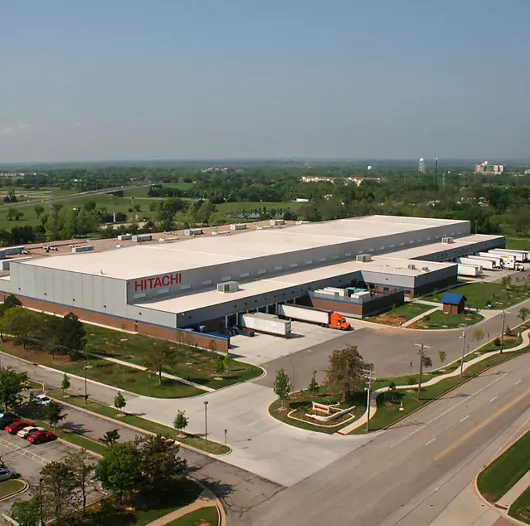
As demand for AI-ready infrastructure climbed, our facility in Norman, OK, shifted toward highly customized storage solutions, the kind of products the AI era requires. That shift brought the readiness gap home fast. Products grew more complex. Critical data sat in systems that didn’t talk to each other. Demand concentrated hard at the end of every quarter, which meant the plant could look capable on paper and still struggle to convert finished orders into revenue on time.
So the Norman team did the work that readiness demands. It pulled inventory data and decision-making onto a single global digital platform, allowing the people running the floor to work from one live picture instead of a dozen stale ones. The team added AI-enabled configuration automation to absorb the complexity that was slowing production. And it built a proactive, end-to-end orchestration model, anticipating what was coming rather than reacting to what had already gone wrong.
The results weren’t incremental. According to the World Economic Forum, the site reduced inventory by 50% and shortened order-to-ship lead times by 77%. A quarter-end crunch that once throttled revenue became something the operation could absorb and deliver against.
Why Outside Validation Matters
In June 2026, the World Economic Forum named the Norman facility a Global Lighthouse, one of the newest sites in a network of 238 of the most advanced operations in the world. Norman earned a Distinction in Productivity, and the designation came from an independent panel of experts.

Plenty of companies will tell you their infrastructure is built for the AI era. Far fewer have had a third party walk the floor and confirm they operate at that level. Hitachi Vantara builds the architecture enterprises need to become AI-ready, and our own plant just got certified as proof the architecture holds up when you run it hard.
There’s a phrase Hitachi leadership uses for this, and it fits: Customer Zero. Before we ask a customer to trust a system, we run it ourselves, in a real operation, against real volatility, with real numbers on the line. Norman is what Customer Zero looks like when it pays off.
The Takeaway for Everyone Stuck at Capable
If your AI investments aren’t yet landing where they’re supposed to, the fix probably isn’t more capability. It’s the readiness underneath it — the data, the governance, and the orchestration that let intelligence move through an operation instead of pooling in pilots. Our research is blunt about the stakes. The organizations that invest in infrastructure, governance, and trusted partnerships win big, and the rest are left counting losses while competitors turn insight into dollars.
Norman is one site that closed the gap, with an outside panel willing to say so. The same gap sits in front of every enterprise trying to make AI pay. Closing it is the whole game.
Hitachi Vantara’s 2025 State of Data Infrastructure Global Report, “From Fragile to Optimized,” surveyed more than 1,200 IT leaders across 15 markets. Read the executive summary.
 Tena Coppedge