Hybrid cloud adoption isn’t slowing down any time soon, with worldwide IT spending expected to total $6.08 trillion in 2026 — an increase of 9.8% from 2025. The pace of growth, driven by AI adoption and data center investment, means many IT leaders face a common dilemma: With 70% of CIOs citing governance and compliance as their top challenge in cloud adoption, how can enterprises embrace Azure governance and automation, without abandoning SAN investments that underpin mission-critical workloads?
Until recently, Azure Local was synonymous with hyperconverged infrastructure (HCI) and Storage Spaces Direct (S2D). Now, Azure Local offers support for external SAN storage, allowing businesses to maintain their existing SAN strategies while embracing Azure’s cloud-based operations. At the heart of this collaboration is SAN - Hitachi VSP One Block, for practical modernization paths that avoid unnecessary complexity.
With external SAN support, Azure Local offers choice without compromise, enabling:
- SAN economics and operational discipline while gaining Azure Arc integration, policy-based governance, and lifecycle automation.
- Modernization of on-prem without disruption as Microsoft’s migration pathways into Azure Local are expanding, making transitions smoother for virtualized estates.
- Alignment with sovereign and disconnected patterns in Azure’s roadmap—critical for regulated industries and edge deployments.
IT leaders can now modernize at their own pace—fast or slow.
Modern Use Cases for SAN in Hybrid Cloud
Azure Anywhere
The Challenge: Enterprises are moving some workloads back and forth between on-prem and Azure due to optimization strategies for performance and costs. But, they don't want to rebuild a complex, legacy datacenter.
Real-life Example: In 2025, JPMorgan Chase publicly stated they’re actively leveraging a hybrid and multi-cloud approach, combining AWS, Azure, Google Cloud, and private infrastructure to balance innovation and resilience. This model protects them from vendor outages and pricing volatility, while ensuring compliance with regulatory and data-sovereignty requirements.
The Solution: Financial service and insurance companies can leverage technology like Azure Local + VSP One Block, which offers a hybrid cloud storage foundation. Doing so allows enterprises to use on-prem economics with cloud-like operations, powered by enterprise-grade storage.
Edge & Distributed Computing
The Challenge: Traditional FC SAN is traditionally too complex and expensive for multi-site deployments (e.g., 500 retail stores). Instead, the market has ceded to HCІ.
Real-life Example: In mid‑2025, Walmart invested $1.2 billion in edge computing infrastructure across its 4,600+ stores to enable real-time inventory tracking, personalized offers, and faster checkout. The program processes over 10 petabytes of data daily, enabling sub‑10 ms response times, reducing restocking time by 40%, and decreasing out-of-stock events by 25% — a strategic use of edge computing to improve customer experiences and operational efficiency while leveraging centralized oversight.
The Solution: VSP One Block + Azure Local enables a "Hub and Spoke" model, which reintroduces centralized SAN benefits without the old complexity. Instead of deploying full SANs at every location, this solution offers a central site with enterprise-grade storage and governance, as well as lightweight edge nodes at individual locations that connect back to the hub for data services, all while running local workloads.
Hybrid Cloud AI Data Plane
The Challenge: Enterprises must keep a single governance and MLOps model across Azure Local and SAN, while aligning AI’s data‑gravity and sovereignty needs with low‑latency, secure, and consistent access to distributed data.
Real-life Example: As reported in December 2025, GSK is using Azure Local to run real-time AI inference and telemetry in manufacturing and research facilities worldwide, maintaining operational autonomy and compliance. These environments require secure, low‑latency AI processing while disconnected mode can support critical operations when internet connectivity is unavailable. This approach ensures sensitive data remains on-prem, while allowing centralized governance and innovation through hybrid capabilities.
The Solution: Azure Local provides AI tools with native support for NVIDIA GPUs, AKS for containerized ML, and Azure ML integration. Hitachi SAN brings the data foundation, including sub-millisecond Novem latency for training and inference, multi-petabyte capacity for foundation models, and instant cloning of massive datasets for experiments and snapshotting of training checkpoints.
How VSP One + Azure Local Work Together
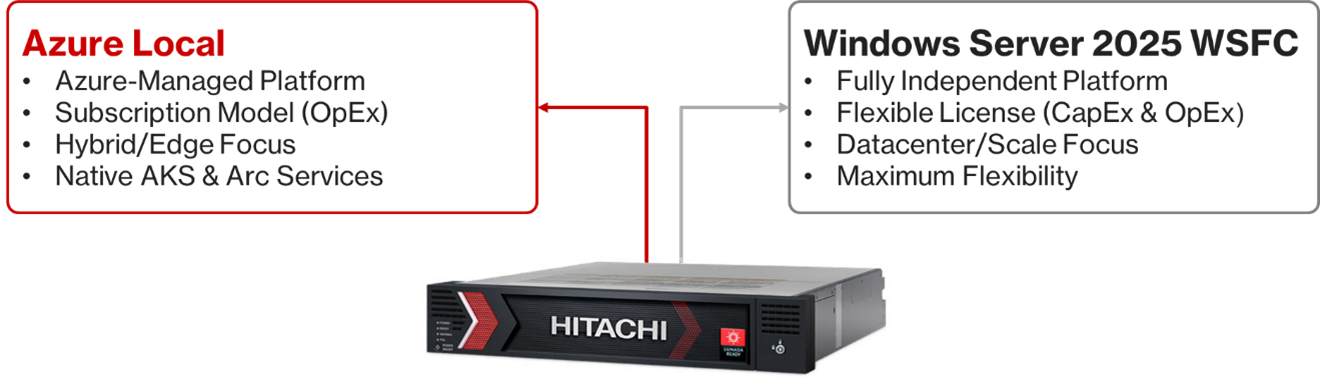
For enterprises, the SAN remains a constant. For Microsoft-focused customers, the key strategic choice is selecting which platform—Azure Local or Windows Server—and the operating model to use. SAN – VSP One Block offers both options with a modern, robust platform. VSP One Block brings guaranteed availability for uninterrupted operations and advanced data services into Azure’s operational model (like data reduction and eco-efficiency features like Dynamic Carbon Reduction), with options to scale confidently for any workload profile. A unified data management suite also offers predictive analytics and automated remediation, as well as SAN services under an Azure-consistent operation.
Your Invitation to a Limited Public Preview
In cooperation with Microsoft, we have opened a limited public preview for customers who want to validate Azure Local + VSP One SAN attach in real-world environments. This program focuses on:
- Fibre Channel attach and SAN configuration patterns.
- VM lifecycle operations through Azure Arc.
- Patch and resiliency scenarios, including path-fail handling.
- Backup and DR options tailored to enterprise needs.
Ideal candidates include regulated or sovereign sites, SAN-first estates, and teams looking for a unified platform that runs virtual machines and containers.
→ Request access now: [contact your Hitachi representative]
Capacity is limited, and enrollment will be phased to ensure quality onboarding.
Azure Local is evolving to meet enterprise choices, not force trade-offs. Learn more about how Hitachi Vantara is partnering with Microsoft in that journey.
 Jeff Cheng