
On UMC H Electronics’ automotive electronics production lines, one finished unit comes off every 20 seconds, around the clock, every day of the year. The IT infrastructure underneath those lines doesn’t get to fail. Even a one-second system delay translates directly into productivity losses on a line that doesn’t stop.
When rapid growth in the automotive business pushed UMC H’s legacy infrastructure to its limit, the company chose Hitachi Vantara servers and storage to rebuild it. UMC H knew Hitachi Vantara hardware in a way few customers do: the company itself manufactures and tests it.
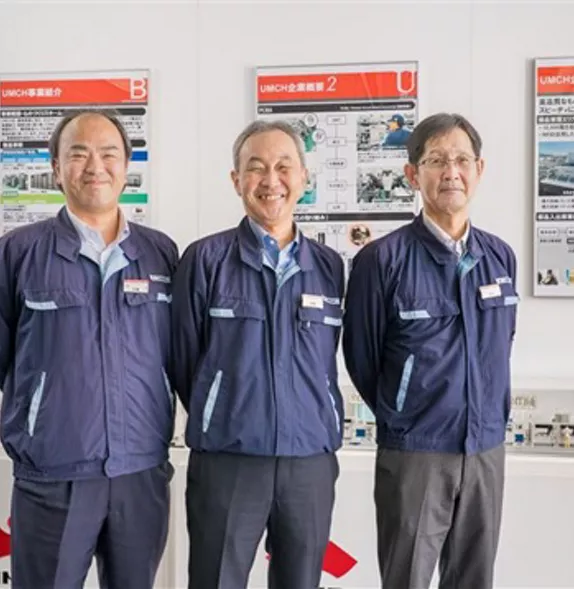
Hiroyuki Mizukoshi, President, UMC H Electronics Co., Ltd.

Location
Hardware
Software

Hiroyuki Mizukoshi, President, UMC H Electronics Co., Ltd.
From Hitachi subsidiary to global manufacturer
UMC H Electronics was established in 2018 when a Hitachi subsidiary responsible for the group’s information and communications infrastructure products integrated with UMC Electronics, a globally operating manufacturing company. The combined company kept the high-reliability manufacturing discipline of its Hitachi heritage and added UMC Electronics’ scale and cost competitiveness, then expanded beyond IT into automotive and industrial equipment.
The automotive electronics business has grown fastest. Over the past five years, UMC H’s automotive production lines have expanded from one to seven, and the data its production management systems handle has grown exponentially alongside.
The new infrastructure had to support UMC H’s Manufacturing Execution System (MES) — an in-house-developed platform that runs alongside the ERP system from parent company UMC Electronics. UMC H uses both cloud and on-premises environments depending on the workload, but the MES was never going to leave the factory floor.
“It was clear our existing infrastructure was approaching its limits,” says Hiroyuki Mizukoshi, President. “At that pace, it would not have been able to support future business growth. A comprehensive modernization of our IT infrastructure was imperative.”
Why on-prem, why Hitachi Vantara
“Our automotive electronics production lines produce one unit every 20 seconds,” says Madoka Tanouchi, Director & Factory Manager. “Even a one-second delay in system response can lead to productivity losses that directly affect operations. Given those real-time requirements and the need to protect highly sensitive data, an on-premises environment was the optimal choice.”
UMC H evaluated servers and storage from multiple vendors. What ultimately decided the call was something most customers don’t have access to: direct visibility into the manufacturing of the products themselves.
“We subject Hitachi Vantara products to extraordinarily rigorous quality testing — including high-load tests and temperature variation tests performed under extreme conditions,” Tanouchi notes. “Because these products consistently meet such stringent standards, we were confident their reliability is exceptional.”
Takahiro Kotsugai, Manager, IT Group, Manufacturing & Engineering Department, adds another perspective: “We also operate Hitachi Vantara servers as production systems on behalf of our customers. In real-world operation, they simply do not fail. They run stably for extended periods of continuous operation. Experiencing that level of reliability day after day led us to choose Hitachi Vantara products for our most mission-critical production lines as well.”
Three days. Non-consecutive.
The new system uses three servers and two storage systems, with significant resource headroom and a clear path to scale by adding servers or upgrading CPU and memory. The hardest part of the project was the migration, which had to happen during the factory’s August 2025 scheduled shutdown.
“Because of planned power outages for factory maintenance, we effectively had three days for the work — and those days were non-consecutive,” Kotsugai says. “In that window, we had to complete everything, including the migration from the legacy virtualized environment to Hyper-V.”
Hitachi Systems led the application migration and Hitachi Vantara provided hardware-level support, including on-site engineers. The three companies — UMC H included — worked as one team and brought the system into operation on schedule.
One detail captures how close the partnership ran. “The servers we introduced were tested and ultimately assembled on our own production lines,” Kotsugai says. “Because my name appeared as the requester on the manufacturing order, shop-floor staff joked that ‘a server with Kotsugai’s name on it is coming down the line.’ That gave me a genuine sense of attachment to those servers.”
Quiet stability, room to grow
Since cutover, UMC H’s automotive production has continued without incident.
“Even after the cutover, the system was so stable and uneventful that it almost made me uneasy,” Kotsugai says.
The architecture is built to scale. Resources can grow with demand, both by adding servers and by upgrading CPU and memory.
“Even as the business continues to grow, this configuration will support our operations effectively for at least the next five years,” Mizukoshi says. “Even in the event of a sudden surge in orders, the lead time before production allows us to scale resources in a planned manner, giving us the confidence to pursue further business expansion.”
Tuning toward 4x — and a smart factory
Performance still has room to climb. The HDD-to-SSD storage upgrade alone is expected to deliver up to four times faster response times once UMC H finishes fine-tuning the new virtualization platform together with Hitachi Vantara and Hitachi Systems.
Some of that tuning is already underway. When UMC H considered switching the server BIOS to high-performance mode for maximum throughput, the team was concerned about the impact on UPS (uninterruptible power supply) backup capacity in the event of a power outage. “Hitachi Vantara conducted a detailed power consumption analysis,” Kotsugai explains, “and confirmed that even with the high-performance settings enabled, the UPS could continue supplying power for the required 10 minutes to ensure a safe shutdown.”
The infrastructure renewal also marks the start of UMC H’s smart factory initiative. The company sees Hitachi Vantara as a strategic partner beyond hardware — particularly on AI-driven predictive maintenance.
“Going forward, we hope to share insights and know-how on the latest technologies, including AI, through communities such as the Hitachi Vantara user community,” Tanouchi says. “One area of particular focus is predictive maintenance — identifying and resolving potential problems before machines begin to show signs of trouble. Sharing successful use cases from other companies will be extremely valuable.”
Kotsugai sees a second dimension to the data opportunity: knowledge transfer. “By consolidating the vast amounts of data distributed across the factory and analyzing it with AI, this data can be used not only for predictive maintenance but also to help transfer the know-how of skilled technicians to the next generation,” he says. “By storing this consolidated data on Hitachi Vantara’s high-performance servers and applying advanced AI analytics, we want to realize next-generation manufacturing together with Hitachi Vantara.”